

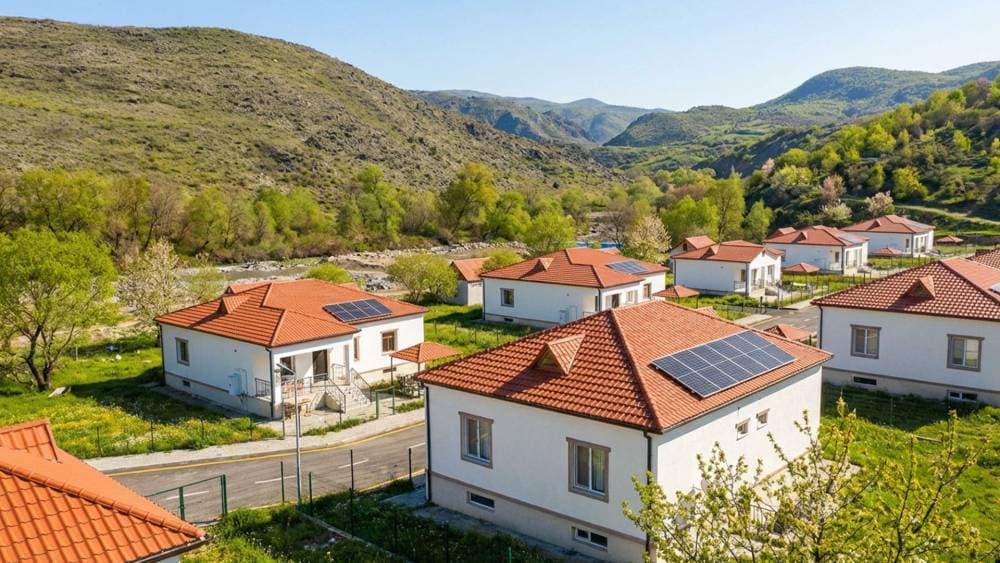
Projects carried out in Azerbaijan to create "green energy" zones and rebuild the territories liberated from occupation stand out for both their scale and their complexity. The Shukurbeyli project delivered by Helind Enerji is not just a single solar power station built on empty land. It is a huge "distributed energy" infrastructure with a total capacity of 2.35 MW, in which each of exactly 635 different homes has been individually equipped with a solar energy system. So how are complex, state-scale projects like this managed successfully?
📌 Key takeaways
- Distributed scale: the project installed more than 4,000 high-efficiency solar panels, not on one site but across the roofs of 635 different homes.
- Logistical excellence: supplying hundreds of homes with equipment at the same time and synchronizing installation requires high-level project management.
- Standardized quality: there is no difference in engineering and safety standards between Home #1 and Home #635; every roof was analyzed individually.
- State and B2B trust: the Shukurbeyli project is a reference proving Helind Enerji's ability to make entire residential areas and settlements fully "green".
Not 1 station but 635 different projects: where is the real challenge?
Installing 4,000 panels in a large field and distributing those same panels across the roofs of 635 separate homes require completely different engineering approaches. Each home's roof has a different angle, sun orientation, degree of shading and load-bearing capacity.
Our engineering team designed not one system but 635 different microsystems. For each home:
- a structural analysis of the roof was carried out,
- special aluminium frames resistant to wind and snow loads were selected,
- safe, fire-resistant DC cabling was installed without spoiling the look of the home.
The logistics and management behind 2.35 MW
Behind the timely, flawless delivery of a project on this scale stand Helind Enerji's strong supply chain and human resource management:
- Synchronized execution: dozens of installation crews and engineers worked on different streets at the same time, speeding up the process.
- Tier-1 equipment: all 635 homes use high-output, long-lasting panels and inverters from Tier-1 brands that meet the same global standards.
- Individual and overall monitoring: thanks to the systems installed, every resident can track their own energy production, while the energy balance of the whole settlement is kept under control.
The "Helind" signature on state and mega-projects
When investing in large-scale reconstruction projects, state bodies, construction companies and industrial giants prefer to work not with individual contractors but with corporate partners able to take on the whole load. At Helind Enerji, we take full responsibility, from customs and logistics to the error-free, simultaneous handover of hundreds of homes.
❓ Frequently asked questions (FAQ)
Q: How long does it take to equip more than 600 homes with solar panels at once?
A: It depends on the number of engineering crews and the construction stage of the homes. With proper management and well-sequenced logistics, mass installations like this are completed in phases within a few months.
Q: How is safety (fire and so on) ensured in large residential areas?
A: Every home is individually fitted with short-circuit protection systems, special solar (DC) cables and automatic circuit breakers. No panel that hasn't passed Helind's laboratory testing goes up on a roof.
Q: If the homes' roof structures differ, does panel efficiency drop?
A: Before installation, our engineers carry out a 3D shading analysis for each roof. Where needed, structures with different angles are used to ensure maximum sun exposure for every home.
Planning a new residential area, village or infrastructure project of national importance?
For "green energy" solutions that cover hundreds of properties and demand flawless logistics and professional engineering, contact Helind's engineers. However large your scale, we have the solution!