

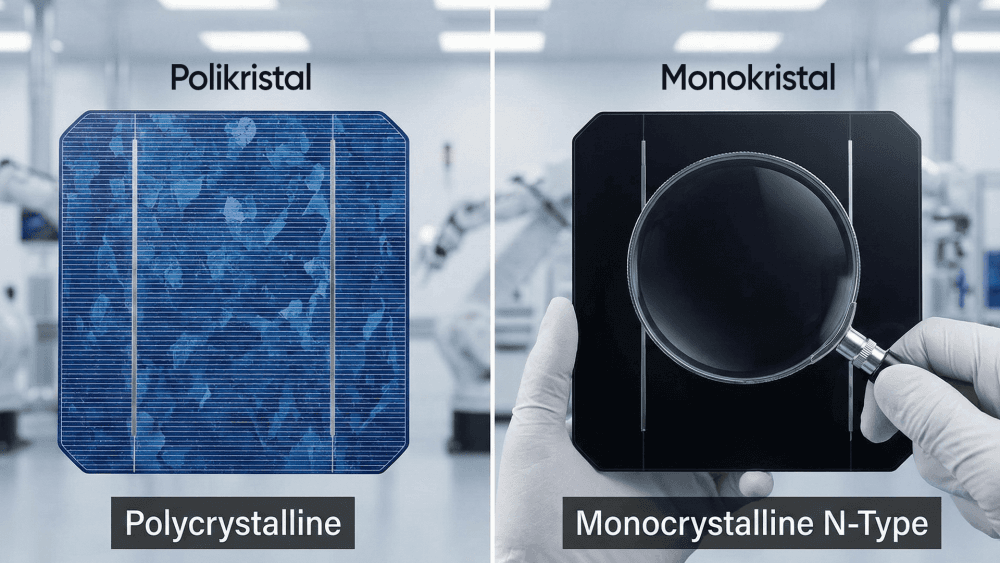
Anyone shopping for solar panels sees two types at first glance: one blue with a mosaic pattern (polycrystalline) and one completely black with a smooth surface (monocrystalline).
Sellers often say: "The blue one is cheaper, the black one is more expensive, but both produce power."
That may have been true in 2010. But in 2026, the technology has changed completely. If someone offers you a polycrystalline panel today, they are most likely trying to sell old technology left over in a warehouse.
Why did Helind Enerji give up "blue" panels and switch to N-Type monocrystalline technology in all our projects? Let's explain with physics and numbers.
💡 Key points:
- Polycrystalline (blue): old technology. Lower efficiency; it heats up quickly in hot weather and loses power.
- Monocrystalline (black): cut from a single crystal, so electrons move faster. It delivers more energy from less space.
- Helind's choice (N-Type): we go beyond standard monocrystalline and install N-Type panels with a 30-year warranty.
- Appearance: black panels look more stylish and modern on the roof.
1. What is the difference? A "gravel road" vs an "asphalt highway"
The main difference between the two panels lies in the purity of the silicon (crystal).
- Polycrystalline (poly = many): as the name suggests, it is made from melted silicon fragments. As electrons move, they bump into the boundaries between crystals. It's like driving on a gravel road: you slow down.
- Monocrystalline (mono = single): cut from a single, whole, high-purity silicon crystal. This is a smooth "asphalt highway". Electrons flow freely, which means more energy.
2. Why is polycrystalline becoming history?
Polycrystalline panels were once popular because they were cheap. But as production technology improved, monocrystalline panels came down in price and the gap became negligible.
The drawbacks of polycrystalline:
- Low efficiency: converts only 15–17% of sunlight into energy (22–25% for monocrystalline).
- Poor heat tolerance: on Azerbaijan's hot summer days (40°C+), polycrystalline output drops sharply.
- More space: it takes up more roof space for the same power.
3. The Helind standard: what is N-Type monocrystalline?
At Helind Enerji, we don't settle for "good"; we aim for "the best". That's why we have moved on from standard (P-Type) panels too and prefer N-Type technology.
Advantages of N-Type technology:
- No LID (light-induced degradation): ordinary panels lose 2–3% of their power in the first year once exposed to sunlight. With N-Type panels, this loss is almost zero.
- 30-year warranty: where standard panels last 25 years, N-Type technology delivers stable energy for 30 years or more.
- Performance in cloudy weather: more sensitive to low light.
4. The big comparison: numbers don't lie
| Feature | Polycrystalline (old) | Standard monocrystalline (P-Type) | Helind N-Type monocrystalline |
| Colour | Blue | Black / dark blue | All black |
| Efficiency | 15–17% | 19–21% | 22–25%+ |
| Heat tolerance | Weak | Medium | Excellent |
| Lifespan (performance) | 20–25 years | 25 years | 30+ years |
| Price | Cheapest | Medium | Premium (good value) |
Frequently asked questions (FAQ)
Question: Are monocrystalline panels more expensive?
Answer: At first glance they may seem slightly more expensive. But over 30 years, thanks to the extra energy they produce, monocrystalline panels end up far cheaper than polycrystalline.
Question: My roof is small. Which should I choose?
Answer: Monocrystalline, without question. High-efficiency panels are the only way to get maximum power from a limited area.
Question: Which brands do you use?
Answer: We work only with global leaders on the Bloomberg Tier-1 list (Longi, Trina Solar, Jinko, Aiko and others) and import the latest N-Type models.
🔬 Don't spend money on old technology
Choose the latest technology for your home or business. Contact us and our engineers will calculate the difference N-Type panels make.
📞 Contact: +994 50 678 99 11
Author: Helind Enerji – the cutting edge of technology.