

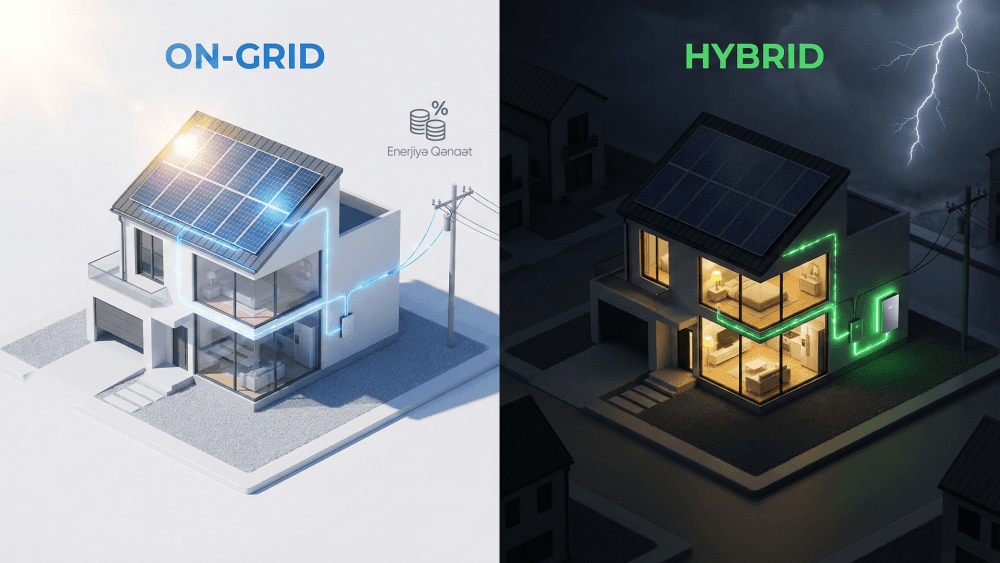
You have decided to switch to solar energy. Congratulations! But the first technical question you face may confuse you: "Do you need an on-grid or a hybrid system?"
Many customers think that once solar panels are installed, their home becomes an "autonomous island". The reality, however, depends on the type of system you choose. The wrong choice can mean either spending money you didn't need to or being left in the dark when the power goes out.
Helind Enerji's engineers will compare these two systems in plain language, without drowning you in technical terms.
💡 For those who don't have time to read the whole article:
- On-grid (grid-connected): the cheapest system and the fastest to pay for itself. But when the city power goes out, it goes out too.
- Hybrid (with battery): more expensive, but it does not leave you without power during outages (UPS function).
- Golden rule: if power cuts are rare where you live, on-grid is more cost-effective.
- Battery life: remember that panels last 30 years, while batteries last 5–10 years depending on the type.
1. On-grid system: "affordable and simple"
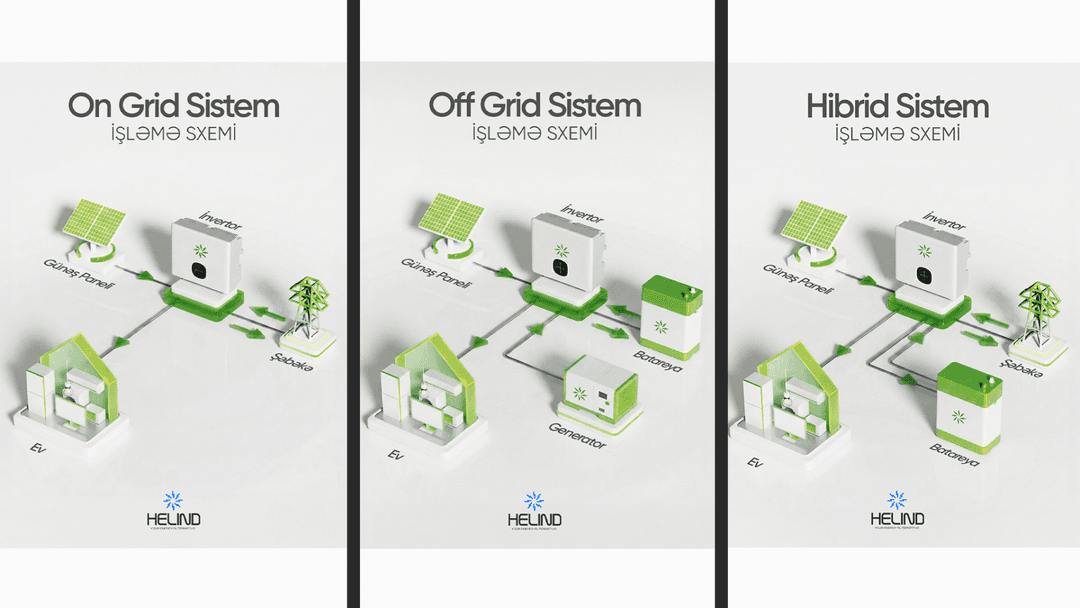
This system runs in parallel with the Azerishig grid. It has no battery.
- How does it work? You use the energy from the sun at home straight away. You sell the surplus to the state (net metering). At night, you take energy from the grid.
- Who is it for? Country homes with stable electricity, city-centre residents, industrial facilities and areas with a stable power supply.
- Advantage: with no battery cost, the system is 30–40% cheaper and pays back your investment faster (in 4–7 years).
- Disadvantage: under safety rules, as soon as the city grid goes down, the on-grid inverter shuts down automatically too. This protects the lives of electricians working on the line.
2. Hybrid system: "full independence"
This system is connected to the grid and also stores energy in special batteries (lithium-ion or gel).
- How does it work? During the day, it powers your home and charges the batteries. It can still export the surplus to the grid. When the city power goes out, the system switches to battery mode within milliseconds.
- Who is it for? Areas with frequent power cuts, country homes, hospitals and businesses where downtime is not an option (server rooms).
- Advantage: you are insured against power cuts. Comfort comes first.
- Disadvantage: batteries are expensive and need replacing after a certain number of years.
3. The big comparison table
To make your decision easier, look at this table:
| Feature | On-grid (grid-connected) | Hybrid (with battery) |
| Installation price | 💰 Economy (low) | 💰💰💰 Premium (high) |
| Works during power cuts? | ❌ No (shuts down) | ✅ Yes (keeps running) |
| Selling surplus energy? | ✅ Possible | ✅ Possible |
| Maintenance cost | Very low (wiping the panels is enough) | Battery monitoring required |
| Payback period | 4–5 years | 6–8 years |
| Ideal customer | Factories, city homes with stable power | Villas, homes in the regions, offices |
4. Engineer's advice from Helind: what is "Hybrid-Ready"?
Some customers say: "I don't have much money right now, so I'll install on-grid and add a battery next year."
Careful! If you buy a regular on-grid inverter, you will not be able to connect a battery to it directly. To avoid replacing the inverter and paying extra in the future, we can offer you "Hybrid-Ready" inverters.
These devices work without a battery and also let you add a battery whenever you want in the future.
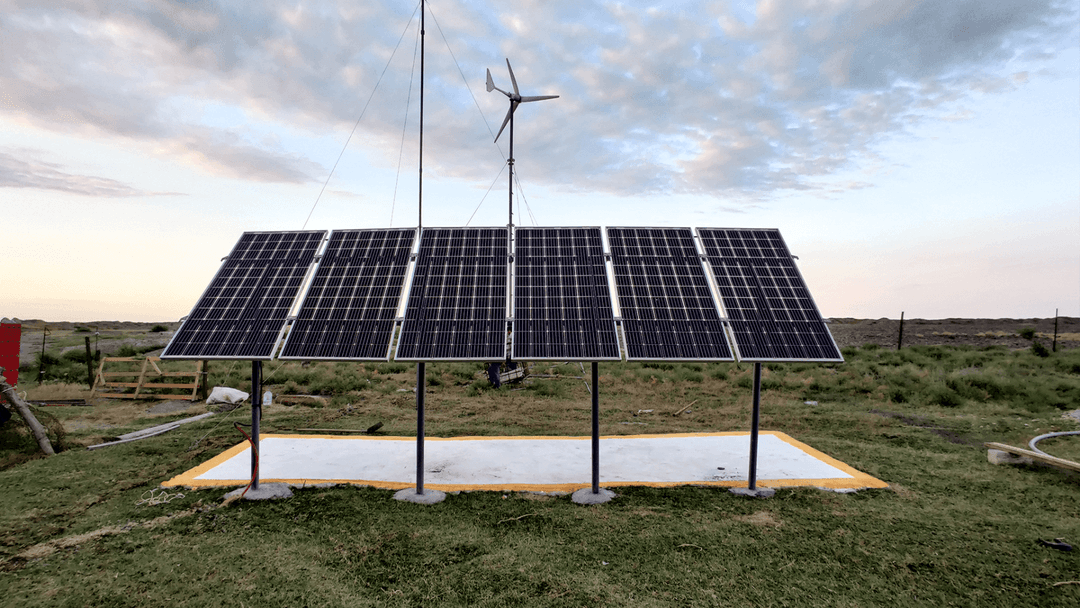
A hybrid solar and wind energy system with batteries installed by Helind Enerji at a country house in Khizi
Frequently asked questions (FAQ)
Question: Can I run my air conditioner on a hybrid system?
Answer: Yes, but it depends on your battery capacity. An air conditioner uses a lot of energy. If you want to run the whole house on batteries, your battery bank must be large (and expensive). We usually recommend connecting the "essential loads" (fridge, lights, internet, boiler) to the battery.
Question: Are batteries dangerous at home?
Answer: The modern lithium iron phosphate (LiFePO4) batteries we use are fire-safe, can be installed indoors and have a long life.
Question: So what is off-grid?
Answer: Off-grid is a completely grid-independent system for homes such as those on mountaintops, where there is no Azerishig line at all. Off-grid is not recommended in urban areas.
⚖️ The choice is yours, the calculation is ours
Still undecided? Send us your location. Our engineers will analyze how often the power goes out in your area and your energy needs, and offer you the most suitable (and wallet-friendly) system.
👉 [Compare on-grid and hybrid prices]
📞 Hotline: +994 50 678 99 11
Author: Helind Enerji – choosing what's right for you.