

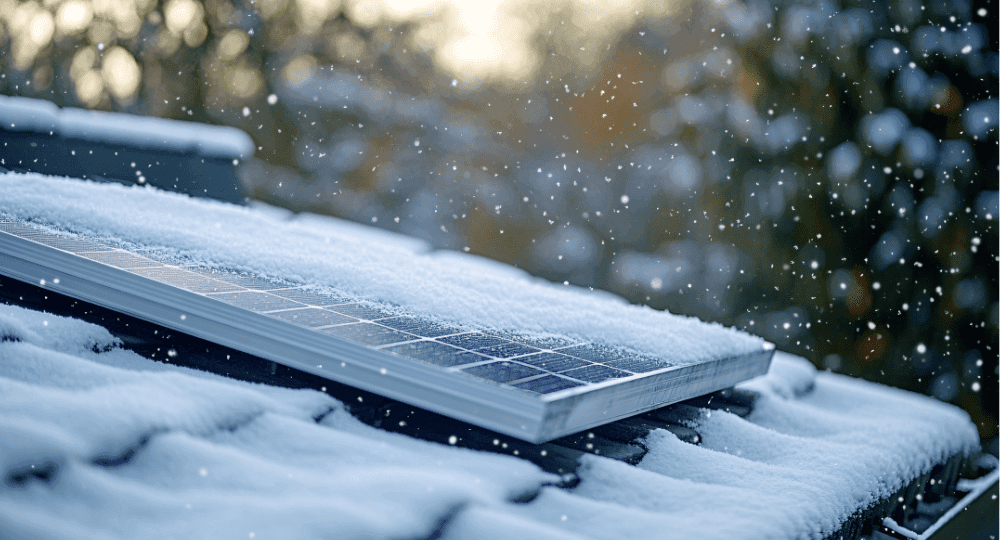
If you think solar panels don't work in winter, let us happily correct you: that is completely wrong.
Yes, the days are shorter and the weather may be cloudy. But that does not mean the solar energy system stops altogether. In fact, in some cases solar panels can work more efficiently in cold weather.
In this article, we answer all your questions about solar panel performance in winter, from both the technical and the practical side.
1. Can solar panels be more efficient in cold weather?
Yes. Solar panels run on light, not heat.
This is where most people get it wrong: a panel doesn't need heat to produce more energy. On the contrary:
- high temperatures reduce panel efficiency;
- cold air keeps the electron flow more stable → higher output voltage.
That is why solar energy systems sometimes reach their peak performance in cool but sunny weather.
2. Factors that affect solar panel performance in winter
a) Fewer sunny hours
- In winter, the sun is out for less time → total energy production falls.
- But this is only a temporary slowdown in production; the system keeps working fully.
b) Cloudy weather
- Good panel technologies (for example, monocrystalline half-cut) can produce energy from diffuse light too.
- Even on cloudy days, panels keep working at 10–30% of their power.
c) Clearing snow
- If snow builds up on the panel, it blocks the light.
- However:
- solar panel surfaces are glass and slippery, so snow slides off quickly;
- panels are usually installed at a tilt, so snow doesn't stay long;
- it is also worth not forgetting to clean the panels in such weather, just in case.
Companies like Helind Enerji choose these angles with special optimization when installing a system.
3. Changes in energy supply: is special winter preparation needed?
If you have an on-grid solar panel system (one that runs in parallel with the electricity grid), no special measures are needed in winter.
- Even if production falls, energy comes from the grid.
- Surplus energy produced in summer can balance winter consumption (if you have net metering).
For off-grid systems, extra battery reserves should be planned for winter, but these are rarely used in Azerbaijan. Off-grid systems, meaning solar systems with batteries, are mainly recommended for areas without a power line.
4. Is there enough sunlight in Azerbaijan in winter?
Absolutely! Many regions of Azerbaijan, especially Ganja, Shaki, Mingachevir and Nakhchivan, receive 2,800+ hours of sun a year.
Even in winter:
- Baku averages 3–4 hours of sunshine a day;
- that is enough for a solar energy system to run reliably.
5. What can you do to improve performance?
- The panel angle can be adjusted for winter, which helps capture more light.
- Keep an eye on dirt and snow: 1–2 technical inspections a year are enough.
- Use a quality inverter and monitoring system, which optimize output even in weak light.
Final word: winter doesn't kill energy, it just requires a plan
Winter is not a dead season for solar panels. Energy production simply changes, and that change should be planned for. After all, total production and output across summer and winter are counted over the year, and that is how real savings on your electricity bill appear.
If the system is designed correctly, even winter is no obstacle to switching to solar energy.
At Helind Enerji, we offer:
- system design balanced for winter and summer;
- optimization of panel angles;
- site-specific simulation and an energy report.
Get in touch now.