

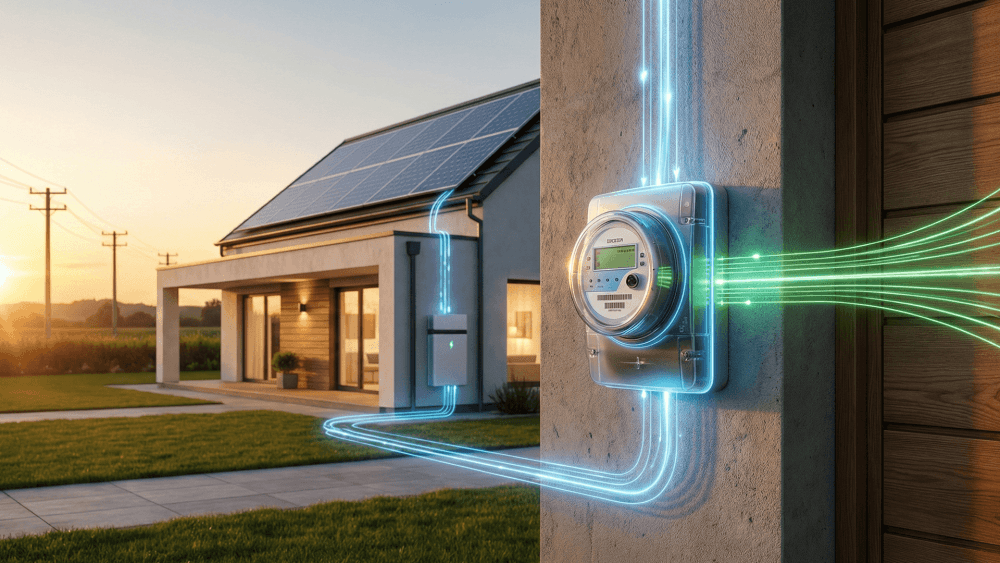
Have you ever thought that your electricity meter could be not just a device that counts your costs but also a source of income?
In the traditional system, you are simply a consumer: you receive energy and pay for it. With solar panels, however, you gain the status of an "active consumer". This means you both produce energy and feed the surplus into the national grid (Azerishig OJSC).
So how is this process regulated? What happens in winter, when there is less sun? Helind Enerji's specialists explain the net metering system in force in Azerbaijan.
💡 Key points for those who don't have time to read the whole article:
- The grid is your "battery": you put the surplus energy you produce into the grid as a "deposit".
- Legal basis: the process is officially regulated by Cabinet of Ministers Decision No. 400.
- A special meter: your home needs a bi-directional meter rather than a standard one. "Smart" meters count both the energy you take from the grid and the energy you feed into it.
- Zero debt: with a properly sized system, you can bring your annual electricity bill down to zero. The system counts the energy you "give" and the energy you "take".
- If you have given more energy to the grid, it stays on your balance (carries over to the next month and is settled at the end of the year).
- If you have taken more energy from the grid, you only pay the difference at the end of the month.
- Paperwork: Helind Enerji handles obtaining the technical conditions and replacing the meter for you.
1. What is net metering?
Put simply: around midday, your solar panels produce more energy than your home needs. If nobody is home, where does that energy go?
In older systems, this energy was lost. In on-grid systems, it is automatically fed into the grid and credited to your balance.
At night, when the panels are not working, you draw electricity from the grid. At the end of the month, Azerishig simply looks at the difference:
- Scenario A: you fed 500 kWh into the grid and took 300 kWh.
- Result: +200 kWh stays on your balance (credited as a deposit).
- Scenario B: you fed 200 kWh into the grid and took 400 kWh.
- Result: you only pay for the 200 kWh difference.
2. "Paying" for winter costs in summer
In Azerbaijan's climate, summers are long and sunny and winters are short and cloudy. That is exactly why net metering is ideal.
From May to September, you produce far more energy than you need. This surplus builds up in your "virtual account". From November to February, when the boiler and heaters are running, you simply use that stored energy without paying for it.
Engineer's note: if there is an electricity grid where you live, an on-grid system is the most cost-effective choice for you. Battery systems (hybrid/off-grid) are expensive, and battery life is limited to 5–10 years. In a grid-connected system, your "battery" is the state itself: unlimited capacity and free of charge.
3. Legislation and paperwork: we handle it for you
Many customers are put off by bureaucracy: "Who will deal with Azerishig, who will change the meter?"
This is where Helind Enerji steps in.
Our turnkey service includes:
- Obtaining technical conditions: preparing the project to state standards.
- Installing a bi-directional meter: the SMART meter counts both incoming and outgoing energy.
- Handover: officially commissioning the system.
You simply sign the contract, and our team carries out all the remaining technical and legal procedures.
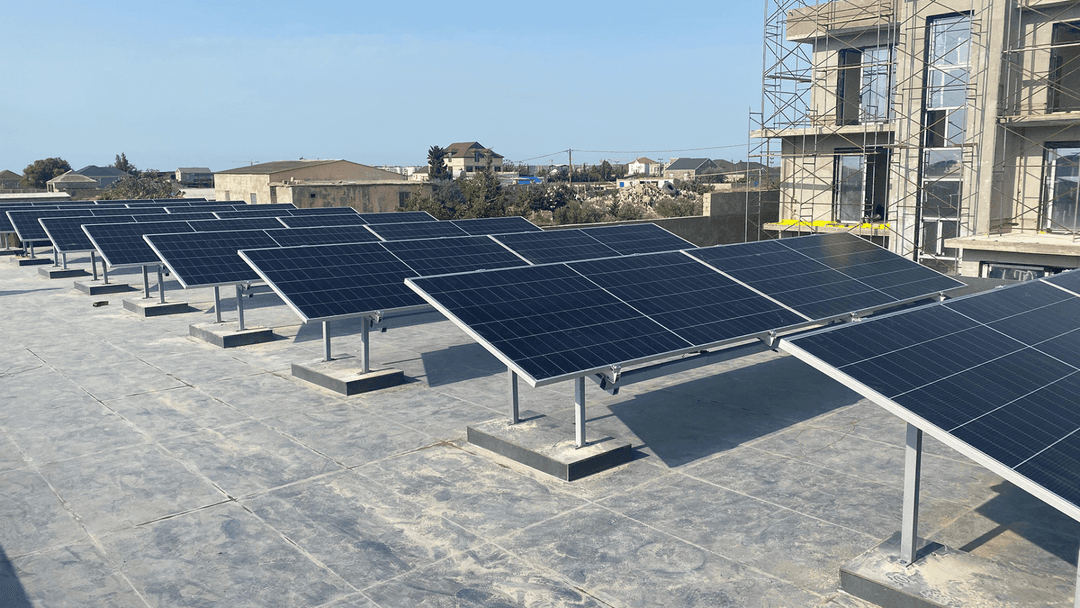
On-grid solar panels and a bi-directional meter system installed by Helind Enerji engineers at a private home
4. Does the state pay me money?
This is the most common question. Under the law, if energy is still left on your balance at the end of the reporting period (usually the end of the year), Azerishig buys it from you at the wholesale tariff.
However, for home (B2C) users, the main goal is usually not to receive cash but to eliminate the electricity bill entirely.
Frequently asked questions (FAQ)
Question: Will my panels work during a power cut (an outage)?
Answer: Under safety rules, pure on-grid systems shut down automatically when the grid goes down (so that line workers are not electrocuted). If you want power during outages too, you should choose a hybrid system.
Question: Is replacing the meter paid?
Answer: Replacement with a bi-directional meter is done according to official state fees. At Helind, we include these costs in the project estimate and present them to you transparently.
Question: Can this system be installed on older houses?
Answer: Yes, the main conditions are a roof suitable for panels and an existing Azerishig subscriber code (technical conditions).
☀️ Activate the "treasure" on your roof
The sunlight that falls on your roof unused every month is really the money you pay for electricity. Let's stop that waste.
We do a free initial analysis of your roof using satellite imagery.
👉 [Click here for a free analysis and calculation]
📞 Hotline: +994 50 678 99 11
Author: Helind Enerji – your energy alternative.